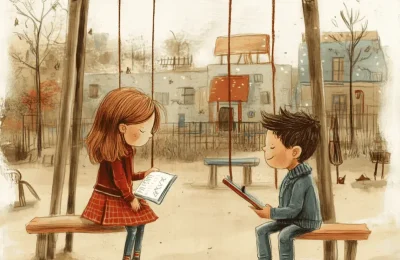


Today I want to talk about one of the central ideas from Yuri Menyacikhin’s original program “I see you,” where he revealed the three core parts of the adult psyche: the inner child, the adolescent, and the adult. He highlighted one of the main problems of the modern person – living not from the adult state, but from a pseudo-adult state, where we try to solve adult problems from an adolescent position.
This topic is especially close to me. While working through my inner child traumas, I noticed there was another layer of my psyche — adolescent in nature — that had been entirely in my blind spot.
Unfortunately, there is very little relevant material on this subject in psychotherapeutic literature. But by a fortunate coincidence, I came across this course and it was there that I got answers to all my questions. I realized how critical this topic is for anyone moving toward their wholeness and happiness. Because a happy person can only be someone who has restored harmony between their inner parts and learned to build life from an adult position.
Below I will briefly describe the key differences between the inner child, adolescent, and adult. If this topic resonates with you and you want to learn more, I recommend taking the course yourself.
Stages of psyche formation
Imagine that at the moment of birth, the first room appears in a child’s inner house called the psyche. As the child grows, each new day creates a new room filled with content made up of lived experience. This content shapes our desires, fears, uniqueness, and creates us as personalities.
If we divide all these rooms into main sections by the criteria of ability to communicate with the world and what attention is directed at, we can identify three full floors in this inner house.
First floor: the inner child
From birth to age 7, a child goes through the formation of adaptation to independent life. When this period ends, the child can be considered autonomous enough to be sent to school.
During this period, the emotional states of the psyche are formed. So when we experience any emotions, we can safely say that we are returning to our inner child.
What attention is directed at:
The child’s attention is focused on play, following the authority of parents, requesting them to serve their needs, and getting their attention.
Characteristics:
Often our inner child is deeply underloved — somewhat wild, stubborn, and can be very capricious.
The transitional stage from child to adolescent (ages 7–10/11) is not covered in this article to keep the focus clear.
Second floor: the inner adolescent
There are two main stages: early (11–14 years) and late adolescence (14–18 years).
During this period, feelings are formed — a sustained, conscious, established attitude toward someone or something that lasts for an extended time (from days to years, unlike emotions, which last at most an hour).
If you have fallen into an emotional experience driven by feelings, you have entered the adolescent part of your personality.
This is also when adolescent pride forms — the desire to be special, chosen.
What attention is directed at:
Orientation toward peers. The authority figures are now peers or other external figures (idols, older companions, etc.). The leading direction is building intimate personal relationships with peers.
How they shape their life:
The adolescent plays at being an adult, trying to combine adolescent interests (freedom, development, socializing) with adult life — and this is where the main conflict occurs.
Core needs:
Feeling their special status in egregores (through developing their talents, abilities, appearance), sexual needs, a sense of independence (beginning to seek resources and territory). They don’t want to be responsible for their craft, business, money, or relationships — overall avoidance of responsibility. No capacity for sustained, steady attention toward acquiring resources. They strive to receive admiration, so the social circle they spend time in matters greatly. Being alone is unbearable, as it creates a feeling of being unwanted. They are constantly worried about something, experiencing states of confusion, uncertainty in their decisions, leaving things unfinished. Decisions are made based on the parameter of cool or not cool, how will I look in others’ eyes — not on what is optimal for me. A lot of pride. There is a fear of making a final choice, so they manipulate and reconsider decisions already made.
Unique positive things in the adolescent part:
Our true creativity, inspiration, and new ideas live in the adolescent part. The adolescent deeply wants to be seen for who they really are. Our dreams and the energy of development are here. Without the inspired adolescent, we have no life energy. They need to be free and creative, so they must be given freedom and resources.
During adolescence we test our models of interaction with society, attitudes toward sex and partners, define our positions in social hierarchies, and get data on how much we stand out and are valued in our social environment. Unfortunately, many of these things are never revisited in adult life, and people continue using attitudes formed by their adolescent self.
Third floor: the inner adult
Forms after age 20, when a person becomes fully independent and focuses their attention on developing their mastery. This floor forms in all people, yet very few ever rise to it.
Key difference from the adolescent:
Fearlessness, the ability to look at a situation objectively and act from the common good rather than egocentrism (as with the child) or self-satisfaction and pride (as with the adolescent).
The adult loves, creates, harmonizes the space around them, strives for beauty, balance, and creativity. They are in a state of calm, beauty, harmony, and fearlessness.
Their only authority is God.
How they shape their life:
They exist in reality, in what is actually happening, possessing a mature and clear aspect of personality. They love life, people, nature, animals. They are in mystical contact with the Creator, exploring how He made them. They are fearless. Under stress — surprise, followed by assessing the situation and then making an optimal decision. They gather resources and act. They control their flow of events and change it. They carry responsibility. They live through their projects, doing everything with elegance and precision. They possess self-discipline, do what is interesting for their soul, and through their work reveal the beauty of life. They know how to build relationships and admire the soul of another person.
Living in a pseudo-adult position — and how to recognize it
Unfortunately, most people in society have remained living in the adolescent part of their psyche, which never transitioned into the adult. The main reason is the absence in society of an initiation stage into adult life — we were never shown examples of what it means to be an adult and how to live from an adult position, because our parents also lived in a pseudo-adult position.
In reality, we remained adolescents trying to live like adults based on our own idea of what adult life should be. In this situation, our psyche formed a pseudo-adult position — where decisions that should be made by the adult are made from the state of our inner adolescent.
Because of this, the adolescent becomes deeply exhausted, waiting for this marathon called “adult life” to end, for everything to fall into place so they can just live. They want to do nothing but have plenty of money. Gradually, hope for a successful end to this race fades. This is why a deep fatigue and disillusionment with life sets in.
Key indicators that life is being built from an adolescent (pseudo-adult) position:
– Decisions are made from self-love and pride; in any conflict, the attitude kicks in: you can’t treat me like this! I will show you how I can respond!
– A feeling of exceptionalism — that I am somehow better than others. In the adult position, this is replaced by a sense of uniqueness (I am simply different).
– Avoidance of responsibility and final decisions, especially in personal relationships.
– Doubt about the correctness of one’s actions, confusion about how to live properly.
– Fear of appearing as a failure, as someone who doesn’t know something, who doesn’t understand life.
– An inner critic dictating how things should and shouldn’t be done.
– Adolescents compete; adults live without tension and calmly reveal their uniqueness.
– Expectation of external recognition, focus on getting positive attention and authority; social approval is extremely important.
– Intense negative reaction to criticism.
The main task in exiting the pseudo-adult state is to take the steering wheel of life away from the inner adolescent and give them full freedom.
Characteristics of living from different inner states
Inner content:
– The child is filled with emotions.
– The adolescent with feelings.
– The adult — calm, loving, fearless joy (harmony and fearlessness).
Primary activity:
– The child — play (goofing around).
– The adolescent — building intimate personal relationships with peers (hanging out, have relationships).
– The adult — their craft (and through it — bringing harmony and order to the world).
Attitude toward responsibility:
– The child cannot take responsibility.
– The adolescent never fully takes responsibility — they mostly simulate having taken it, but always leave a gap. Key phrases that reveal the adolescent: maybe, if it works out, we’ll see, etc.
– The adult carries full responsibility and is able to give an answer — why I behave and act this way.
Living in reality:
– The child lives in a fantasy world where everything happening around them is because of them, where the world of their fantasies and reality can freely blend and coexist.
– The adolescent lives in pseudo-reality — living the way they think an adult should live. Because of this, they take responsibility for things they shouldn’t be responsible for and make decisions outside their territory. They try to pull reality toward their idea of what it should be. If you ask the inner adolescent — do you really want to be doing this? — they will answer: honestly, no. Whereas the adult will answer yes.
– The adult lives in reality and perceives it as it is. They see their limitations and possibilities and how these can be applied in their life.
Encountering conflict or the unknown:
– The child falls into confusion (helplessness, since everything depends on others), followed by a split in the psyche (sadness or anger), often making decisions from egocentric interest rather than what is optimal in the moment.
– The adolescent falls into confusion, then into demonstrative displays of strength — I can handle everything, control everything, or this event didn’t affect me at all. In the pseudo-adult position, these demonstrations turn into role-playing.
– The adult does not fall into confusion — they assess the situation, make a decision, and take responsibility for it.
How they behave in life situations:
– The child — however things turned out, let’s leave it, no need to change anything. What matters to them is contact, praise, a feeling of safety. They exist in the here and now.
– The adolescent — activates willpower to show they are strong and demonstrate their adulthood. They often force themselves — just push through and get it done. They have an illusion of their own specialness and exceptionalism, that they have a deal with reality. The adolescent looks for an external authority who will confirm their specialness.
– The adult — they choose what is interesting, what has depth, what holds a desire for self-development and mastery. For them, will is a deep understanding of their intention, so they act without effort. They perceive reality as it is, without illusions. The test question from the adult position: how would a fearless, loving person act in this situation? They don’t seek external authorities — they simply reveal their uniqueness.
Tasks in love
The adolescent — their task is to charm, make someone fall in love, fall in love themselves, form intimate closeness. They want to be chosen by love: they chose, and they must be chosen in return. They want to become special, to stand out.
The adult — they need to see into a person’s soul, to touch it, to choose to live a life together. They admire the soul of another person.
Closing words
In this publication I have briefly described three important inner states of the psyche from which we make decisions. They are already formed and not subject to change, so the main task is to learn to distinguish between them, interact with them, and harmonize their relationships. For example, you can simultaneously experience an emotion from the child state, feel a strong feeling from the adolescent state, but make a decision from the adult state. All three parts of the psyche have their own beautiful characteristics without which our life is impossible — and it is deeply interesting to gradually discover their uniqueness.
It is also important to release the tensions within them and free the energy that remains sealed there from past traumatic experiences. And most importantly — to hand the steering wheel of life from your inner adolescent to your adult part, in order to build a life filled with love and harmony. For this, Menicikhin’s course offers many practices and tools to make it happen.